.3 the need to enable a stand-on vessel to maintain a steady
course, as required by the 1972 Collision Regulations, for as long as possible before the
route junction; and
.4 the need to encourage traffic not following an established
route to avoid crossing at or near route junctions.
Deep-water routes
In designing deep-water routes, consideration should be given to
marking critical turning points. Any wrecks or sea-bed obstructions which lie within the
limits of a deep-water route and which have less depth of water over them than the minimum
depth of water for the route as indicated on the charts, should be marked.
"7 TEMPORARY ADJUSTMENTS AND SUSPENSIONS"
"Traffic separation schemes"
7.1 When the temporary positioning of an exploration rig is
unavoidable, the design criteria and the provisions for planning should be taken into
account before permitting the positioning of the rig or subsequently adjusting a traffic
separation scheme.
7.2 The said adjustments should be made in accordance with the
following:
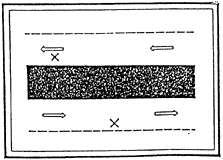
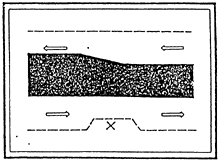
.1 When the drilling location is situated near the boundary of a
traffic lane or separation zone, a relatively slight adjustment of the scheme could have
such effect that the drilling rig and its associated safety zone are sufficiently clear of
the traffic lane;